The Land Run Is Ending
On most days, crypto can feel like a constant onslaught of speculation and extraction, with no way out. That feeling is fair, and earned. What we sometimes forget, though, is that human behavior is downstream of incentives.
History has shown that whenever something valuable and scarce is distributed, the first mechanism gets gamed. What follows is the same chaos we see in crypto today.
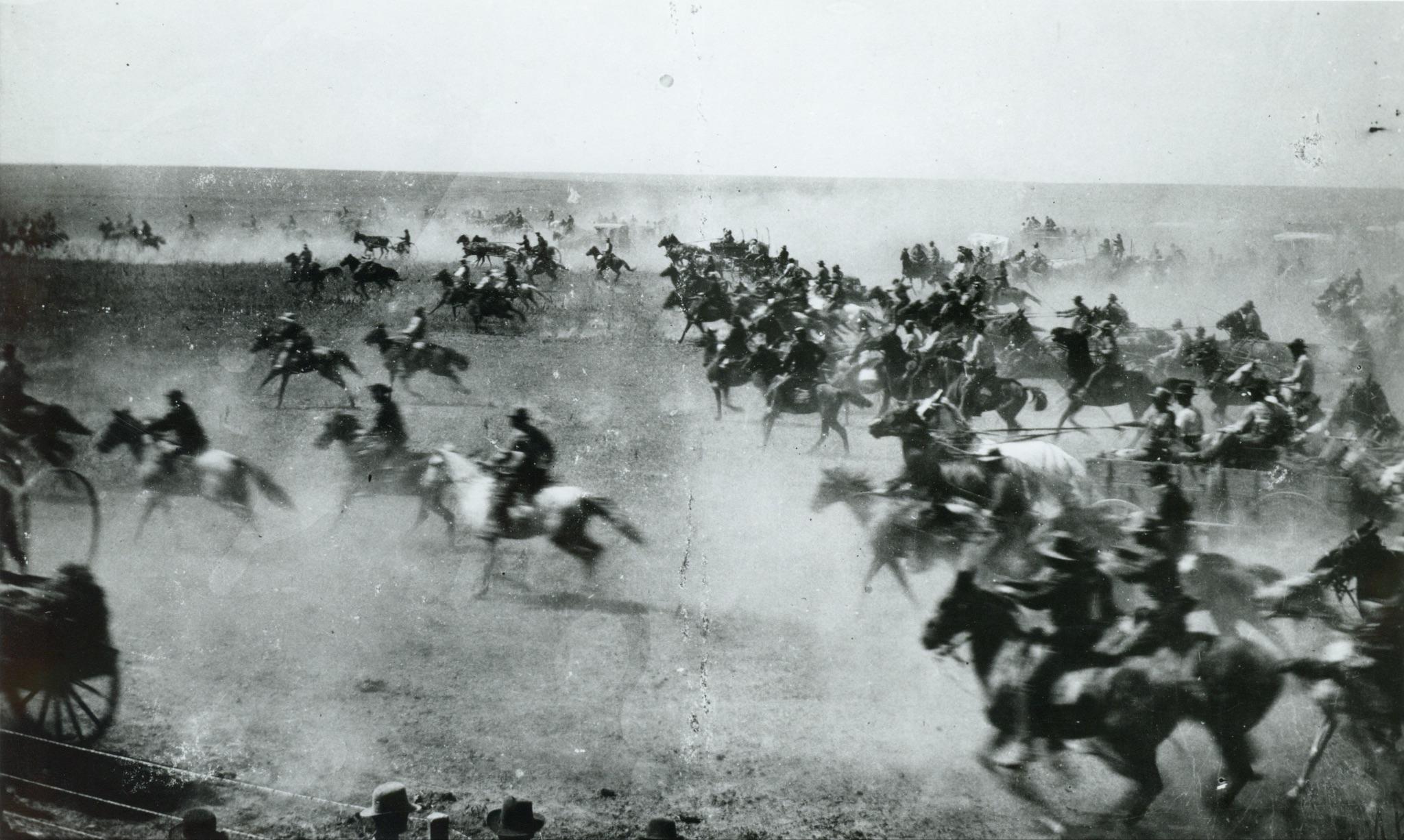
In the 1880s, Oklahoma gave away land through races, the airdrops of their day. "Sooners," the original snipers, slipped in before the signal and took the best claims. By 1895 they held half of all tracts [1]. Fast forward nearly a century: in the 1980s, the FCC used lotteries to give away licenses to the radio spectrum, the airwaves that carry cell phone signals, and "application mills" filed hundreds of thousands of tickets and flipped the winners to real carriers [2].
Each time, a naive mechanism rewards whoever exploits it best, until the value extracted becomes too large to ignore, and a new mechanism is demanded. Crypto is in the middle of that story, and most people misread why.
The Static Bonding Curve
The naive mechanism here is the static bonding curve, popularized by Friend.tech and Pump.fun.
As early as 2025, the sharpest traders were pointing to the bonding curve as a solved game [3]. Most in crypto can sense that it's a broken market structure, and the frustration with snipers is palpable. So why does it still dominate?
It dominates because it solves real problems. A bonding curve lets anyone launch a token in seconds, with no market makers, no order book and a guaranteed counterparty from the very first trade. That's a genuine breakthrough [4]. In traditional markets, creating a new market takes underwriters, exchange listings, market makers and months of work. A bonding curve does it with a single transaction.
For memecoins, where there's nothing to price but attention, that might be all you need. It also pays: launchpads earn fees on every trade, and snipers are some of their most active customers, so the platform has little reason to fight them.
More importantly, nothing has forced a change. A bad mechanism can persist as long as the value lost to exploiting it remains smaller than the cost of replacing it. As launch sizes grow, that calculus changes.
Three Design Choices
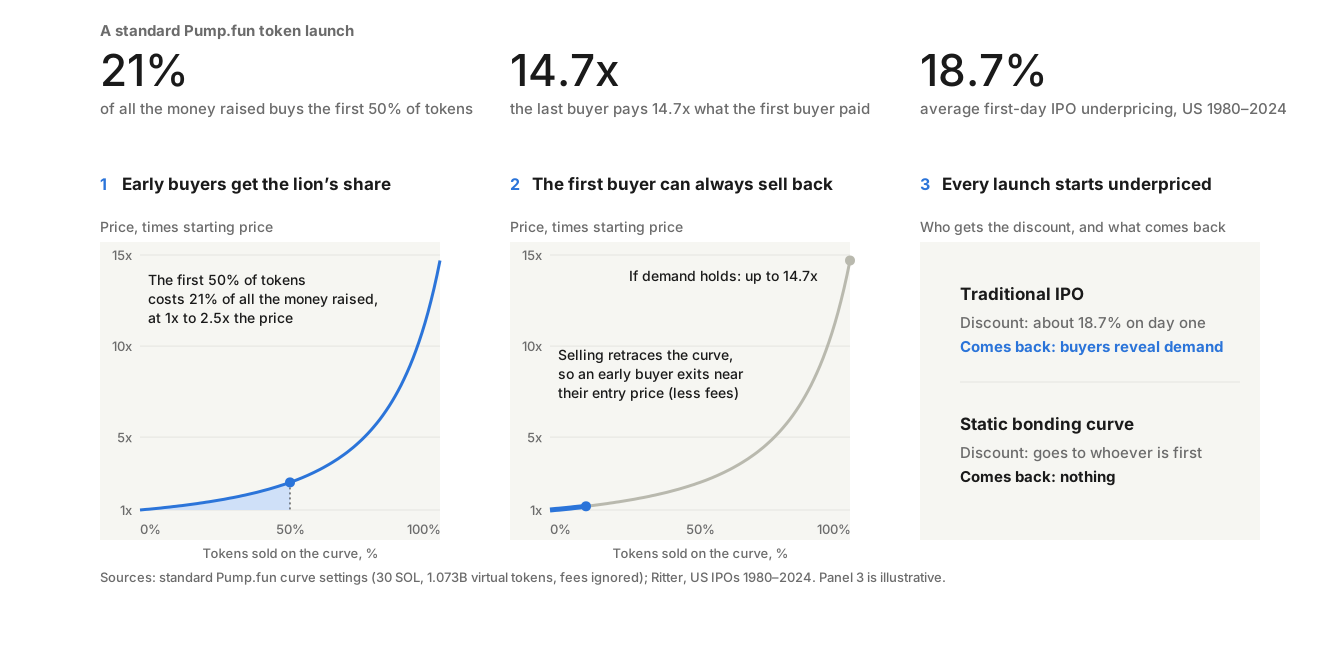
Bonding curves solved market creation, not price discovery. The costs come from three design choices that all reward the same thing: being early. Together, they've trained a particular kind of buyer [5].
- Early buyers get the lion's share: The bonding curve is convex. The price rises slowly at first and steeply later, so the first buyers don't just pay less per token. They capture a disproportionate share of the supply for very little capital.
- The first buyer holds a cheap option: Because the curve never rebalances, an early buyer can often sell back near their entry price if demand fails to materialize, while retaining enormous upside if it does. The earlier the entry, the better the trade.
- Every launch starts underpriced: In traditional offerings, underpricing compensates buyers for revealing information about what an asset is worth [6, 7]. A static bonding curve gives away the same economic rent but extracts no information in return. It simply awards it to whoever arrives first.
Stack those three incentives together, and you get "punt first, ask questions later" as the rational strategy. Once buyers become price-insensitive, issuers optimize for hype, turnover and information asymmetry, because that's what attracts the most demand.
And that's the misread: it isn't a story of bad actors. It's people acting rationally inside a bad mechanism, the same story history keeps repeating. Which means the fix isn't hoping for better behavior. It's designing a better mechanism.
The Frenzy
Economist Carlota Perez, whose work on technological revolutions is a staple in venture circles, describes how every major technology goes through a frenzy before it finds its purpose [8]. In what she calls the installation period, financial capital races ahead of real production, and speculation pays better than building. Britain's railway mania in the 1840s, the boom of the 1920s and the dot-com bubble all followed this pattern.
Crypto's launch market looks remarkably familiar. Before Pump.fun launched in 2024, the total number of failed tokens was in the low hundreds of thousands. In 2025 alone, 11.6 million died, roughly 32,000 a day [9]. Meanwhile, Pump.fun, the platform printing most of them, has earned $322 million so far this year, more than every crypto project but one [10].
Perez's frenzies don't end on their own. They end at a turning point: usually a crash, followed by new rules and institutions that realign capital with real value. After the 1929 crash, one of those new institutions was the SEC itself. Nearly a century later, the same agency is writing the rules for crypto.
The Turning Point
Every bad distribution mechanism grows an industry around exploiting it, until something breaks. In Oklahoma, the chaos turned deadly, and Washington abandoned the race [1]. At the FCC, flipped licenses cost an estimated $190 million in 1991 alone, and Congress replaced the lottery with auctions [2].
In crypto, the pain caused by snipers is already acute, and Regulation Crypto is likely to make it worse. Proposed by the SEC in August 2026, it is the first framework built specifically for raising money through tokens, letting projects sell up to $75 million a year to the public [11]. The catch: every public raise must be filed on EDGAR before a single token is sold, including projects that raised under Reg D and are now taking their token public. EDGAR becomes a public registry for snipers to curate from, and the larger the launch, the more there is to extract.
200 Milliseconds
Consider what happens when a launch is announced in advance. In November 2025, Base co-founder Jesse Pollak announced his creator coin, $JESSE, a day before it went live [12]. The announcement gave every sniper operation a fixed target and a day to prepare.
On paper, Base should have been hard to snipe. It has no public mempool like Ethereum's; its sequencer hides pending transactions until they land. It didn't matter. Snipers watched Base's stream of 200-millisecond "flashblocks," spotted the deployment the instant it appeared, and raced to land their transactions in the very next flashblock. The fastest one paid a $44,000 priority fee to get there first, bought 7.6% of the supply for $189,000, and sold it for over $850,000 [12, 13].
After the Land Run
When the right mechanism finally arrives, the payoff is enormous. Oklahoma's last land run gave way to an orderly lottery in 1901 [14], and six years later the territory became a state. The FCC's spectrum auctions became the gold standard worldwide and raised over $200 billion [15], and their designers, Paul Milgrom and Robert Wilson, won the 2020 Nobel Prize in Economics [16].
The internet turned any piece of information into a packet. Tokens will do the same for value: a protocol's fees, a company's cash flows, an artist's royalties. If everything that can be owned becomes a token, launchers will be as common as websites. The first generation of launchers solved market creation. The next will solve price discovery, built on mechanisms that reward being right, not being first.
Internet Capital Markets are coming, and the land run will end.
P.S. In Part 2, we go deep on three Launch 2.0 mechanisms trying to improve on the bonding curve and reshape how buyers behave: Meteora's Dynamic Bonding Curve, Uniswap's Continuous Clearing Auction and Doppler's Dynamic Auction. We look at how each works, what it fixes, and which, if any, ends the land run.
References
- Oklahoma Historical Society. "Land Openings"; "Sooner"; "Cherokee Outlet Opening." https://www.okhistory.org/publications/enc/entry?entry=LA016
- Federal Communications Commission (1997). The FCC Report to Congress on Spectrum Auctions. https://wireless.fcc.gov/auctions/data/papersAndStudies/fc970353.pdf
- Frank (@frankdegods) (Sept. 28, 2025). "bonding curve game just feels solved." Post on X. https://x.com/frankdegods/status/1972255840301449335
- a16z crypto (2026). "Blockchains Create Net New Markets." https://a16zcrypto.com/posts/article/blockchains-create-net-new-markets/
- Adams, A. (Nov. 26, 2025). "Price Discovery Auctions." Whetstone Research. https://aada.ms/pdfs/pda.pdf
- Rock, K. (1986). "Why New Issues Are Underpriced." Journal of Financial Economics, 15(1–2), 187–212.
- Benveniste, L. and Spindt, P. (1989). "How Investment Bankers Determine the Offer Price and Allocation of New Issues." Journal of Financial Economics, 24(2), 343–361.
- Perez, C. (2002). Technological Revolutions and Financial Capital: The Dynamics of Bubbles and Golden Ages. Edward Elgar.
- CoinGecko Research (2026). "Dead Coins: How Many Cryptocurrencies Have Failed?" https://www.coingecko.com/research/publications/how-many-cryptocurrencies-failed
- The Currency Analytics (Sept. 27, 2026). "Pump.fun Hits $322 Million in 2026, Ranking Second Among All Crypto Projects." https://thecurrencyanalytics.com/defi/pump-fun-hits-322-million-in-2026-ranking-second-among-all-crypto-projects-297765. See also DefiLlama: https://defillama.com/protocol/pump.fun
- U.S. Securities and Exchange Commission (2026). Regulation Crypto Assets (proposed rule). https://www.sec.gov/rules-regulations/2026/08/s7-2026-27. See also Sidley and Morrison Foerster summaries.
- CoinDesk (Nov. 21, 2025). "Snipers Pocket $1.3M Using 'Flashblocks' on Jesse Pollak's Creator-Coin on Base Blockchain." https://www.coindesk.com/business/2025/11/21/snipers-made-usd1-3m-on-jesse-pollak-s-creator-coin-debut-on-base
- bheau (@bh359) (Nov. 20, 2025). X thread on Base flashblocks and the $JESSE snipe. https://x.com/bh359/status/1991565593019814307
- Oklahoma Historical Society. "Kiowa County" (1901 lottery). https://www.okhistory.org/publications/enc/entry.php?entry=KI019
- Priceonomics. "The Spectrum Auction: How Economists Saved the Day." https://priceonomics.com/the-spectrum-auction-how-economists-saved-the-day/
- NobelPrize.org (2020). The Prize in Economic Sciences 2020, press release. https://www.nobelprize.org/prizes/economic-sciences/2020/press-release/