Aztec's CCA: good distribution, unproven price discovery
Summary
Aztec's auction was good at getting tokens to many people on similar terms, and unproven at finding the right price. The data covers Aztec only, drawn from the auction contract's own logs.
- Distribution worked. About 16,700 wallets took part, and most paid a price within a narrow band below the final one. Bidding early earned a small edge.
- Sniping was possible but small. One bidder sold first at the open for a modest gain. The two-month wait before trading probably deterred more of it than the design did.
- Price discovery is the weak point. Nobody could sell during the auction, demand bursts could not be undone, and the market traded below the auction price once trading opened.
- The biggest unknown is whether early-bid profit is predictable. If a CCA can reliably pay early bidders, sniping-style activity could grow. Aztec's two-month wait hides whether the mechanism or the holding risk kept it small.
- The engineering has a cost. A CCA is harder for buyers and routers than a bonding curve, and other designs also spread tokens widely, so the benefit has to justify the complexity.
How a CCA works
A continuous clearing auction sells a fixed supply over time, one block at a time, at a price set by the money waiting to buy it.
- The issuer sets a schedule that says how much supply is released in each block, including stretches where nothing is released.
- A bid is a budget and a max price. It cannot be cancelled or edited. The budget is spread across the supply still to be released, so a bid placed earlier buys more of the early, cheaper blocks.
- Each block has one clearing price, the highest price at which that block's supply sells. Everyone filled in that block pays it.
- The price only rises. A bid whose max price is passed stops spending and can exit with the unspent part refunded.
- The final price opens a trading pool on Uniswap, seeded with part of the proceeds.
The Aztec sale at a glance
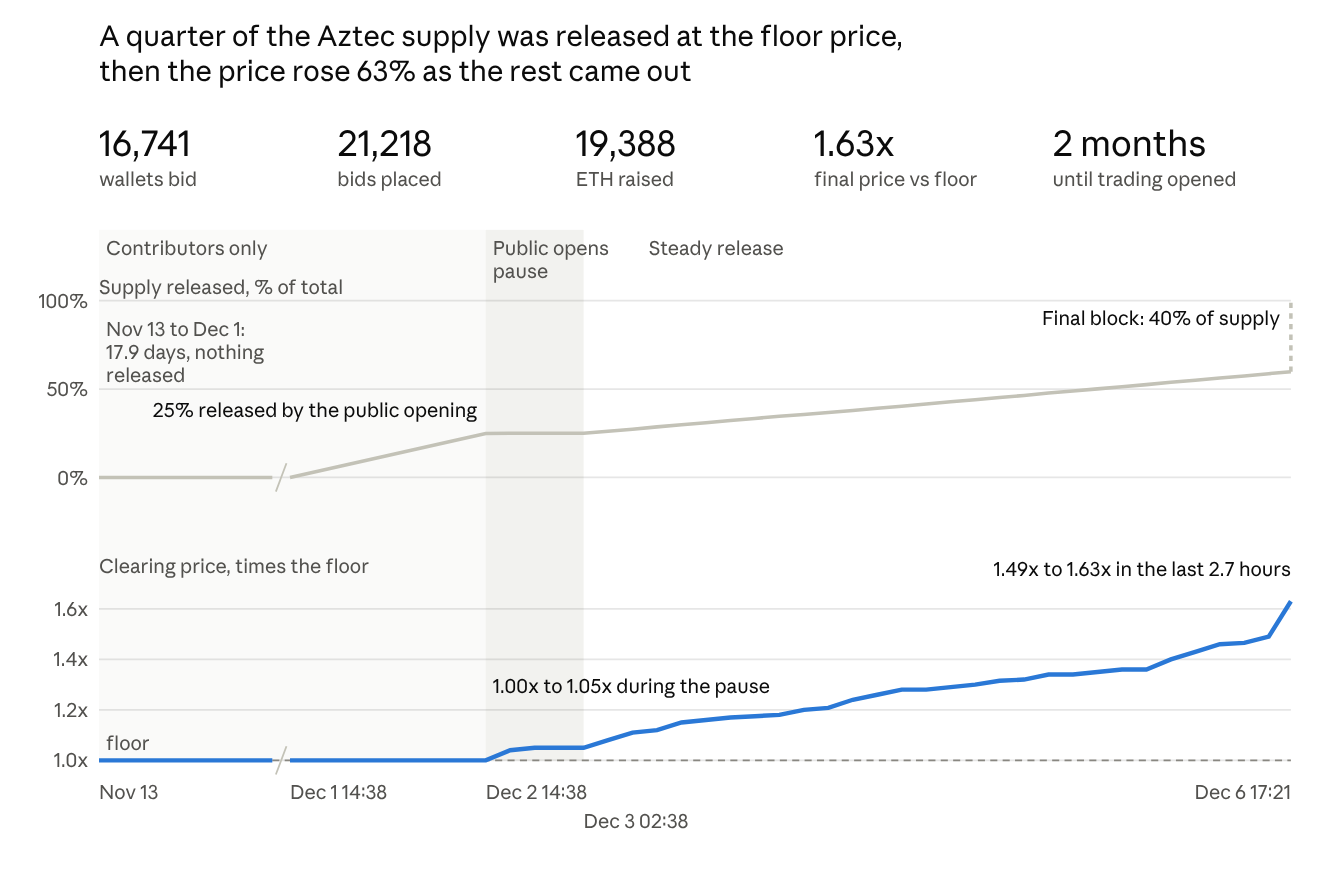
Distribution
Broad participation on similar terms is where the auction did best: everyone in a block paid one price, and the gap between early and late bidders was modest.
- Early bids paid a little less. Among public bidders, the earliest paid about 11% below the final price and last-day bidders paid about the final price. That is the whole spread.
- Contributors had a head start, not a different league. They could bid before the public and paid about 19% below the final price, because the first quarter of supply sold at the floor in a window only they could enter.
- Most people were small. The issuer reports that 96% of bidders put in under $10,000.
Sniping
Sniping was possible but small. The one clear case came when trading opened two months after the auction.
- What happened. In the first transaction of the first block, an auction bidder sold about 17 million tokens, paying a priority fee about 10,000 times the usual one to go first. It had bought them 20% below the final price and cleared about 35 ETH on roughly 213 ETH.
- Inventory risk probably mattered more than the design. Tokens could not be sold for two months, so anyone planning a quick flip had to hold them through that gap at an unknown price. That deters industrial snipers by itself.
So Aztec is not a clean test of the auction's own resistance to sniping.
Did it find the price?
Probably not cleanly. The auction found a price that clears the supply, but three features make it a weak guide to what the token was worth.
- There was no way to sell. Tokens could not be traded until the pool opened two months after the sale. Bidders had no outside price to test their view against, so the only feedback was the auction's own order book.
- Bursts of demand became permanent. The clearing price can only rise. Whatever pushed it up, a rush of conviction or a few large late bids, stayed in the price. The last day alone produced about 43% of the whole rise from the floor.
- Trading opened below the auction price. On the first day of trading the pool sat 11% to 33% below the auction price, then recovered to about 12% below after a day and a half.
The two-month wait contributes to that drop. The pool started at a stale price, so I cannot separate overshoot in the auction from two months of news. The quick partial recovery, in only a day and a half of data, suggests selling pressure and thin liquidity played a part.
So the fair reading is that the auction was very good for distribution and has not shown it found the true price.
Open question: what does removing the fight cost?
If the auction pays naive bidders to bid early, who is left to do the work of finding the price?
In a contested sale, informed bidders compete hard to set the price. A CCA changes the incentives. Bidding early is cheaper, so an uninformed bidder who simply bids early does well. Informed bidders can wait, watch the order book and clearing price, and commit later with more information.
That suggests two consequences to test:
- Price discovery moves late and concentrates Aztec held back 40% of supply for a single final block, which is meant to make the closing price hard to push. Even so, the price kept climbing before that block: the last day alone produced about 43% of the whole price rise.
- Early money adds little information. Most early wallets bid very small amounts, so they are cheap to place and tell the market little.
To test this properly will need an auction where trading opens right away, and a way to tell informed bidders from naive ones, for example by wallet history or size.
The biggest unknown: is early-bid profit predictable?
Aztec shows limited industrial sniping, but it cannot tell us whether that came from the mechanism or from the cost of holding tokens for two months, and that is the main thing still unknown.
- Predictable demand can be sandwiched. Snipers target launches with steady, price-insensitive buying. They trade ahead of the buyers and sell into them, as described for fixed-price sales [1].
- The untested claim about a CCA. In Aztec, bidding early paid because the final price ended above the early price. If the first day of trading had held level instead of dumping, that would have been a profit anyone could have predicted. If a CCA can produce that again and again, bidding early becomes a repeatable trade.
- A repeatable trade attracts capital. Sniping-style activity could then rise. It would not be a simple speed race. It would be positioned capital bidding early and selling at the open.
- There is no way to short before migration. If the price is wrong, nobody can bet against it until trading starts. That lets bursts of demand build and stay, and bursts are the predictable flow a sandwich needs.
The uncomfortable version. If bidding early is predictable, sandwiching can still happen. A sniper can enter the auction like everyone else, then race to sell in the first block after migration. The one clear Aztec case shows this is possible.
What would settle it: a launch that migrates right away, where the correct price changes almost every block and the open market can correct the auction at once. Alongside it, we need evidence on whether bidding early reliably earns a profit, and then to watch how buyer and sniper behaviour change.
Is the engineering worth it?
A CCA asks more of everyone than a bonding curve does, and what it buys, broad distribution and a blunted edge, may be available more cheaply elsewhere.
The cost is real. A CCA is a separate auction mechanism, not part of Uniswap v4 itself. Buyers have to learn how it works, routers have to integrate it, and a bid cannot be traded anywhere. A bonding curve is just buy and sell: most routers support it and the interface is dead simple. Thinking about how a budget is spread across a whole schedule is much harder for an average buyer.
The edge is blunted for informed buyers too. If you hold a convinced view about the sale, there is no clean way to express it, because your bid is split across the entire sale. In practice a buyer has two choices: bid early for a discount of roughly 10% to 20%, or wait and bid once more bidding data is visible. Aztec put 40% of supply in the final block. Uniswap's stated reason is to make the final price hard to push. It also leaves a large share for bidders who wait.
Broad distribution does not need a CCA. Capped pro-rata raises such as MetaDAO's also spread tokens widely. In all of these the edge is mostly money: if you have capital, you can wait until the end, see the demand, and bid then. A CCA blunts that by breaking up the supply, though 40% at the end is still a lot.
So the question for future launches is whether partly blunting that edge justifies the extra complexity for buyers, routers and traders. Aztec shows the benefit was real. It does not show the benefit was worth the cost.
Sources
- Aztec: the ticker is $AZTEC for pre-bid and public dates
- Aztec: TGE next steps for when tokens became transferable
- Uniswap: how Aztec raised $59M for the reported bidder sizes
References
- Adams, A. (Aug. 25, 2025). "A Note on Fixed Price Auctions." Whetstone Research. https://aada.ms/pdfs/fp_auctions.pdf